
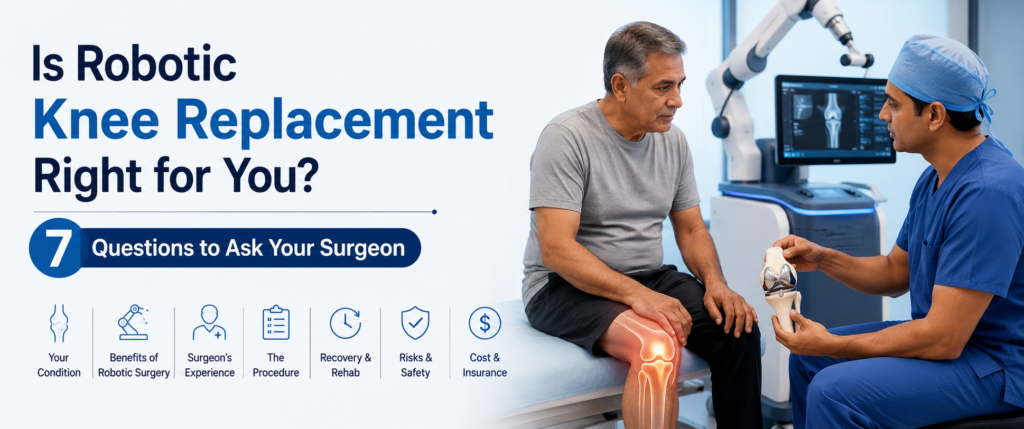
“So, are robots performing surgeries now?” We hear this question (or variations of it) almost every week. It is perfectly understandable: the word “robotic” immediately conjures up images from science fiction movies. However, the reality is far more reassuring —and, frankly, much more promising—once you look at the details. If you are considering knee replacement surgery in Gwalior, you have likely come across the topic of robot-assisted surgery and are probably wondering: is it really worth it, or is it simply a more expensive version of the same procedure?
This is a perfectly valid question that deserves an honest answer, not a sales pitch. Here are seven questions worth asking the surgeon directly before making a decision.
1. Who’s actually doing the surgery — you or the machine?
Let’s clarify this point right away, as it is a common source of misconception: the robot does not operate autonomously. The surgeon makes all the decisions and performs every incision; essentially, the system acts as a high-precision tool that helps position the implant accurately based on a 3D model of your knee joint. You shouldn’t view this as a procedure performed by a robot; rather, it is like a GPS navigator for a surgeon who already knows the route—the system simply enables greater precision during the procedure. Ask your surgeon to explain in detail exactly what functions the robot performs versus the actions the doctor carries out manually. If they cannot provide a clear explanation, that is something worth considering as well.
2. How many robotic knee replacements have you personally done?
This point is more important than almost any other item on the list. Mastering robotic systems requires time and practice—just like learning to use any new tool. A surgeon who has performed a handful of robotic surgeries is generally still climbing the learning curve compared to one who has done this procedure many times over. Do not hesitate to ask this question directly; a good surgeon will not be offended—on the contrary, they will likely appreciate your approach. It demonstrates that you are taking the situation seriously rather than simply following recommendations blindly.
3. Am I actually a good candidate, or would traditional surgery work just as well for me?
It is worth highlighting a point that does not always receive sufficient attention: a robotic system is not necessarily the best choice for every patient. Its use is particularly justified in cases involving complex anatomy, severe deformities, or previous joint injuries that make achieving proper alignment difficult. In uncomplicated cases, an experienced surgeon using traditional instruments can achieve equally successful results. Do not hesitate to ask the surgeon directly whether the use of robotics is truly appropriate for your situation or if the option is being suggested simply because it is available.
4. What does “more precise” actually mean for my recovery?
The concept of “precision” sounds promising, but what exactly does it mean in practice? Typically, it refers to more accurate implant positioning and optimal soft-tissue balance, which theoretically reduces long-term stress on the joint and potentially accelerates recovery. However, the final outcome depends largely on your anatomy, physical activity level, and diligence during rehabilitation. Ask your surgeon for specifics: instead of general statements about “better recovery,” inquire about the typical progression of the process over the weeks and months ahead, based on their experience with other patients.
5. Will this change how long I’m in the hospital or how soon I can walk again?
Some patients believe that robotic surgery automatically guarantees a shorter hospital stay or a faster recovery of walking ability. While this is certainly possible, it is not always the case; timelines depend on the specific surgeon and the patient’s individual characteristics. It is helpful to learn about realistic recovery times for someone of your age, weight, and physical activity level, rather than relying on the ideal scenarios often described online.
6. What happens if something doesn’t go according to plan mid-surgery?
We rarely give this matter much thought, yet it is highly important. Robotic systems rely on imaging data and sensor readings, but technical malfunctions or unexpected anatomical features may force a surgeon to switch to traditional instruments during the procedure. Ask the surgeon what protocol is in place for such scenarios and how often they have encountered this situation in practice. An experienced and confident specialist will provide a clear, specific answer rather than evading the question.
7. What will this actually cost me, and does insurance cover it?
It is easy to get caught up in technical details and overlook practical considerations. Robotic surgeries can be more expensive than traditional ones, depending on the specific clinic and the terms of your insurance. Find out the total cost, the services included, and how your insurance policy covers robotic surgery compared to the conventional procedure. No one wants to face the unpleasant surprise of an unexpected bill during an already challenging recovery period.
So, is it right for you?
To be honest, there is no universal answer to this question, and the claim that robotic knee replacement is invariably the best option for everyone is an oversimplification. For some patients—particularly those with complex knee anatomy or a history of prior surgeries in the area—this technique offers a genuine advantage in terms of precision. At the same time, an experienced surgeon using traditional instruments can achieve equally successful results.
What matters far more than the technology itself is the person holding the tools — their experience, their honesty about your specific case, and their willingness to actually answer your questions instead of brushing past them. If your surgeon takes the time to walk through all seven of these with you, that alone tells you a lot about how your care is likely to go.
Don’t feel rushed into a decision. Ask the questions, compare the answers, and choose the option — and the surgeon — that you genuinely feel confident about. A knee replacement is something you’ll live with for years, so it’s worth getting the conversation right before you get to the operating table.
