
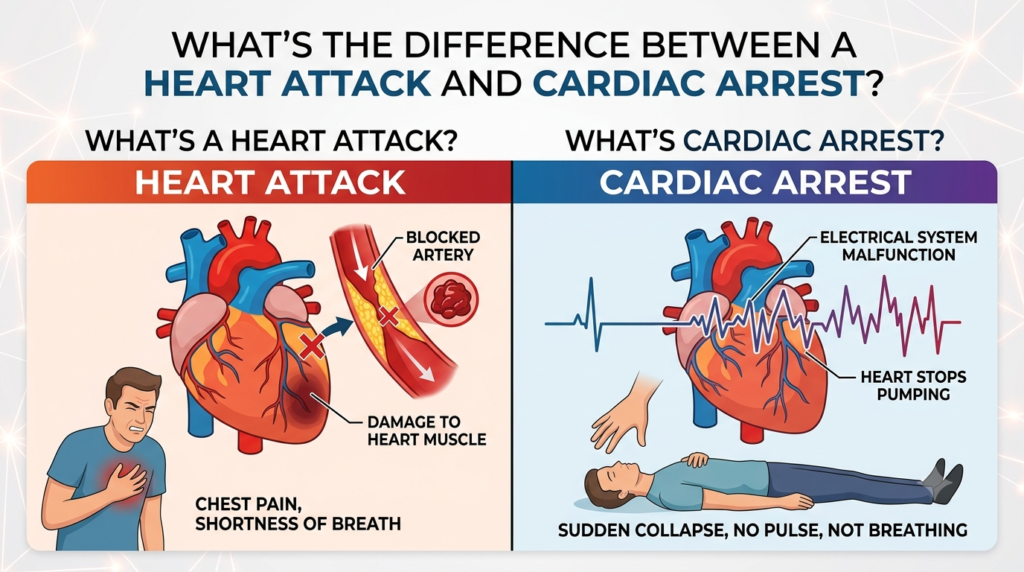
Most people use “heart attack” and “cardiac arrest” as if they’re the same thing. They’re not. And the confusion isn’t harmless — in a real emergency, mixing them up can waste time nobody has to spare. One is about blocked blood flow. The other is an electrical failure. Different causes, different symptoms, different response. Any cardiologist in Gwalior will tell you this is one of the first things worth clearing up with patients, well before it ever becomes an emergency.
Heart Attack: The Plumbing Breaks Down
A heart attack — myocardial infarction, if you want the technical name — happens when blood stops reaching part of the heart muscle. Usually the cause is plaque: fat and cholesterol that build up inside a coronary artery over years, then rupture. A clot forms at the rupture site. Blood flow gets cut off right there.
The heart is still beating through all of this. That’s what surprises people. It’s not that the heart stops — it’s that one section of muscle isn’t getting oxygen, and the longer that goes on, the worse the damage gets.
Symptoms don’t always arrive dramatically. Chest pressure, sure, that’s the one everyone knows. But it can also be pain that spreads into the arm, the jaw, the back. Shortness of breath before anything else. Nausea. Cold sweat. Sometimes just a vague sense that something’s wrong — tired for no reason, a little dizzy, nothing dramatic enough to seem urgent.
That vague version matters more than people think, particularly for women. Female patients are more likely to show up with fatigue or nausea or jaw pain than the classic crushing chest pain. It’s a pattern that comes up again and again in consultations with a cardiologist in Gwalior, mostly because it’s also the pattern most likely to get waved off as nothing.
Cardiac Arrest: The Wiring Fails
Cardiac arrest is a different animal. There’s rarely a buildup, rarely a warning. The heart’s electrical system goes haywire — an arrhythmia so disruptive the heart can’t pump anymore.
Blood stops reaching the brain almost immediately. A person collapses, loses consciousness, and either stops breathing or starts gasping in a way that isn’t actual breathing. No pulse. No warning signs beforehand, usually. Just sudden and complete.
So where a heart attack restricts flow, cardiac arrest shuts the pump off entirely. That’s why it kills within minutes without intervention — there’s no slow decline to catch, just a stop.
The Overlap Nobody Talks About Enough
Here’s the connection that gets missed: a heart attack can lead straight into cardiac arrest. Damaged tissue from a blocked artery can throw off the heart’s electrical signals, and that disruption is sometimes enough to trigger the kind of arrhythmia that stops the heart altogether.
Which is exactly why chest pain shouldn’t get ignored, even when it’s mild, even when it comes and goes. Catching and treating a heart attack early is one of the better ways to stop it from turning into cardiac arrest. Most cardiologists in Gwalior will say this without hesitating — they’ve seen it go both directions.
Why the Difference Changes What You Do
This isn’t just a medical technicality. It changes the actual response.
Someone in the middle of a heart attack is usually conscious. Talking, even if it hurts. The priority is getting emergency help moving — call an ambulance, don’t drive them yourself, because paramedics can start treatment before the person even reaches a hospital.
Cardiac arrest doesn’t allow for that. The person isn’t responding. Isn’t breathing normally. Calling for help is just step one — CPR needs to start right away, because it’s the only thing keeping blood moving to the brain until someone with equipment shows up. If there’s an AED around, use it without waiting. Every minute without CPR or a defibrillator lowers the odds. That’s not an exaggeration — it’s just how the physiology works.
It’s part of why some clinics offering cardiology care in Gwalior now run community sessions on CPR and AED use. Not for doctors. For whoever happens to be nearby when it matters.
Cutting the Risk Down
The mechanisms differ, but a lot of the risk factors overlap — so managing one tends to help with both:
- Keep blood pressure and cholesterol in range
- Manage diabetes if it’s there
- Skip tobacco entirely, no exceptions
- Move regularly, not just occasionally
- Eat real food more often than processed food
- Deal with stress in ways that actually last
- Show up for regular check-ups, especially with a family history of heart disease
An ECG, an echocardiogram, a stress test — these can flag trouble long before it turns into an emergency room visit. Past 40, or with heart disease running in the family, seeing a cardiologist in Gwalior on a regular schedule is one of the more reliable ways to catch something while it’s still manageable.
The Bottom Line
A heart attack and cardiac arrest sound like cousins, but they’re not really alike. One is blocked flow to part of the heart. The other is the heart’s electrical system failing outright, stopping the pump completely. Knowing which is which — and knowing what to do for each — genuinely changes how things turn out.
Given how closely the two are tied together, keeping up with heart health isn’t something to put off for later. Chest discomfort, fatigue that doesn’t make sense, anything that feels off — it’s worth getting looked at instead of waiting to see if it passes. Regular follow-up with a qualified cardiologist is still the most dependable way to stay ahead of it.
