
“But no one in my family has heart problems.” I often hear this statement or variations of it. People usually say this with a sense of relief, as if the fact settles the matter once and for all. In reality, however, the situation is quite different. Any cardiologist in Gwalior who’s been in practice a while will tell you the same thing I do: genetics is just one of many factors. Many patients with no family history of heart disease go on to develop narrowed arteries. Conversely, many people whose parents or grandparents suffered a heart attack around the age of fifty live into their eighties or beyond without ever experiencing a single heart problem.
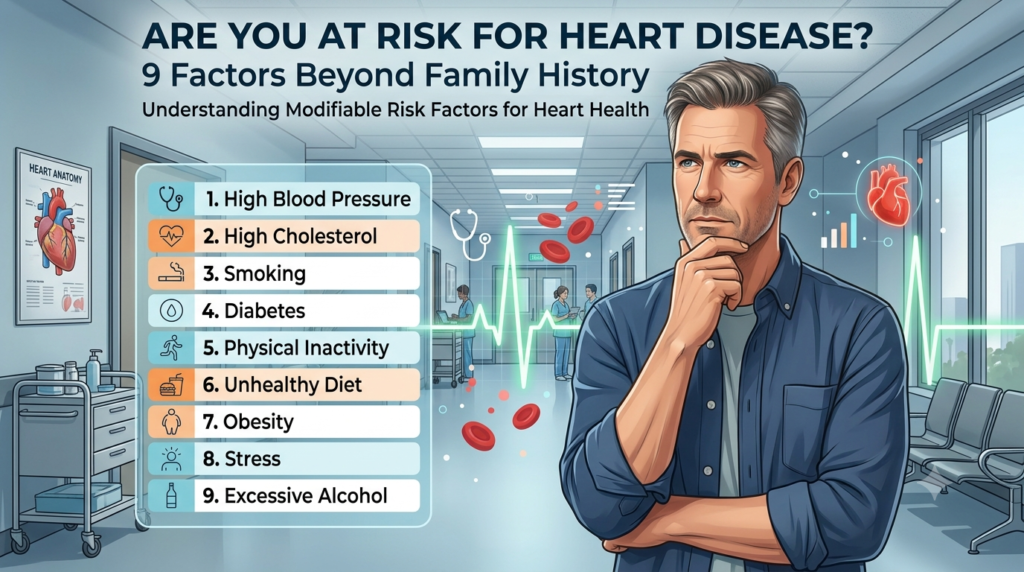
So if family history isn’t the whole story, what is? A lot of it comes down to things that feel too ordinary to worry about — how you sleep, how you sit, how often you actually talk to another human being. Below are nine factors that quietly shape your heart health, whether or not anyone in your bloodline ever had a bypass.
1. Abdominal Fat May Matter More Than Body Weight
Here’s something that trips people up: two people can be the exact same weight and have very different heart risks. It’s not really about the number on the scale; it’s about where the fat sits. Abdominal fat—and especially the visceral fat surrounding internal organs—behaves much like an active endocrine organ. It produces pro-inflammatory substances that irritate blood vessels from the inside. Therefore, if your waistline has increased while your weight has remained virtually unchanged, it is a warning sign that requires attention.
2. Stress that never really switches off
We tend to view stress as a purely psychological phenomenon, but the heart reacts to it differently. During any stressful episode, the release of cortisol and adrenaline triggers a sharp rise in blood pressure and heart rate. In the short term, this poses no threat; however, the situation changes drastically when dealing with a demanding boss, a relationship crisis, or financial troubles that drag on for months. In my view, this is one of the most underestimated risk factors—precisely because it does not show up in blood test results the way cholesterol levels do.
3. Sleep that looks fine on paper but isn’t
There is a difference between spending eight hours in bed and actually sleeping for that entire time. If you toss and turn, snore loudly, or wake up gasping for air, it is not merely an annoyance; the cause could be sleep apnea, a disorder closely linked to high blood pressure. Daytime fatigue is often attributed to age or a hectic schedule, yet the underlying cause may be something else entirely. Therefore, it is worth consulting a doctor, especially if your partner notices that you snore frequently.
4. Sitting. A lot. Every day.
You don’t need to run marathons to protect your heart; however, the habit of spending over eight hours sitting at a desk—combined with commuting time and evening relaxation on the couch—inevitably takes a toll on your health over time. Physical activity maintains the elasticity of blood vessels, helps regulate blood sugar levels, and supports healthy cholesterol levels. And the best part is that achieving this is quite simple: a 30-minute walk—even if not daily, provided it is done regularly—offers far greater benefits than you might imagine.
5. Overall eating patterns over any single “bad” food
I am often asked about specific foods: Is it okay to consume ghee? Is coffee harmful? Should rice be completely eliminated? Honestly, obsessing over a single food prevents you from seeing the big picture. What really matters is what is on your plate day in and day out, not just occasionally. A diet overloaded with processed snacks, refined carbohydrates, and excess salt will eventually lead to hardening of the arteries—even if you do eat a salad now and then. In this regard, consistency is far more important than striving for perfection.
6. Blood sugar trouble before it’s officially “diabetes”
You don’t need a diabetes diagnosis for your blood vessels to already be under stress. Prediabetes and insulin resistance can sit quietly for years, doing damage the whole time, with no obvious symptoms. If it’s been a while since you’ve had your fasting glucose checked — and especially if you’re carrying extra weight around the middle — it’s a cheap, quick test that tells you a lot.
7. Smoking, and yes, vaping too
I’ll keep this one short because most people already know smoking is bad for the heart. What surprises people is that vaping isn’t the safe alternative it’s marketed as. E-cigarettes still deliver nicotine and other compounds that research suggests can damage the lining of your arteries. There isn’t really a version of inhaling smoke or vapor that leaves the cardiovascular system untouched.
8. Loneliness — genuinely, physically
This one often comes as a surprise. Research has linked chronic social isolation to a meaningfully increased risk of cardiovascular disease, with some studies drawing comparisons to well-established risk factors like smoking or high blood pressure. We are social beings; isolation from others (or even the mere perception of it) triggers the same stress mechanisms as a bad job or a difficult relationship. This is not just a matter of emotions—it is backed by research data.
9. Blood pressure, nobody’s keeping track of
High blood pressure gets called the “silent killer” for a reason — it usually doesn’t cause symptoms until real damage is already done. So many patients tell me they got a slightly high reading once at a pharmacy kiosk or during an unrelated checkup, shrugged it off, and never followed up. Left alone for years, even mildly elevated numbers steadily wear down the heart and vessels.
Where does that leave you?
None of these nine elements exists in isolation, and, frankly, that is precisely where the main difficulty lies. People who sleep poorly tend to experience more stress, skip walks more often, and are more likely to opt for fast food or highly processed products rather than cooking for themselves. These risks accumulate imperceptibly—which is why it is so easy to overlook them until a specific situation forces us to take notice.
The good news, if there is one, is that most of this list is actually within your control. You can’t undo your family history. You can improve your sleep, take stress a bit more seriously, move more, and stop putting off that blood pressure check. Catching something early — before it becomes a diagnosis instead of a risk factor — is genuinely one of the best things you can do for yourself.
If even one of these points made you pause, don’t wait around for chest pain to take it seriously. A short conversation with your doctor, a basic blood panel, and a blood pressure cuff will tell you more than any amount of guessing. Heart disease usually builds up slowly, which is actually good news — it means you probably have more time to change course than you think. But that only works if you start now, not after something goes wrong.
